
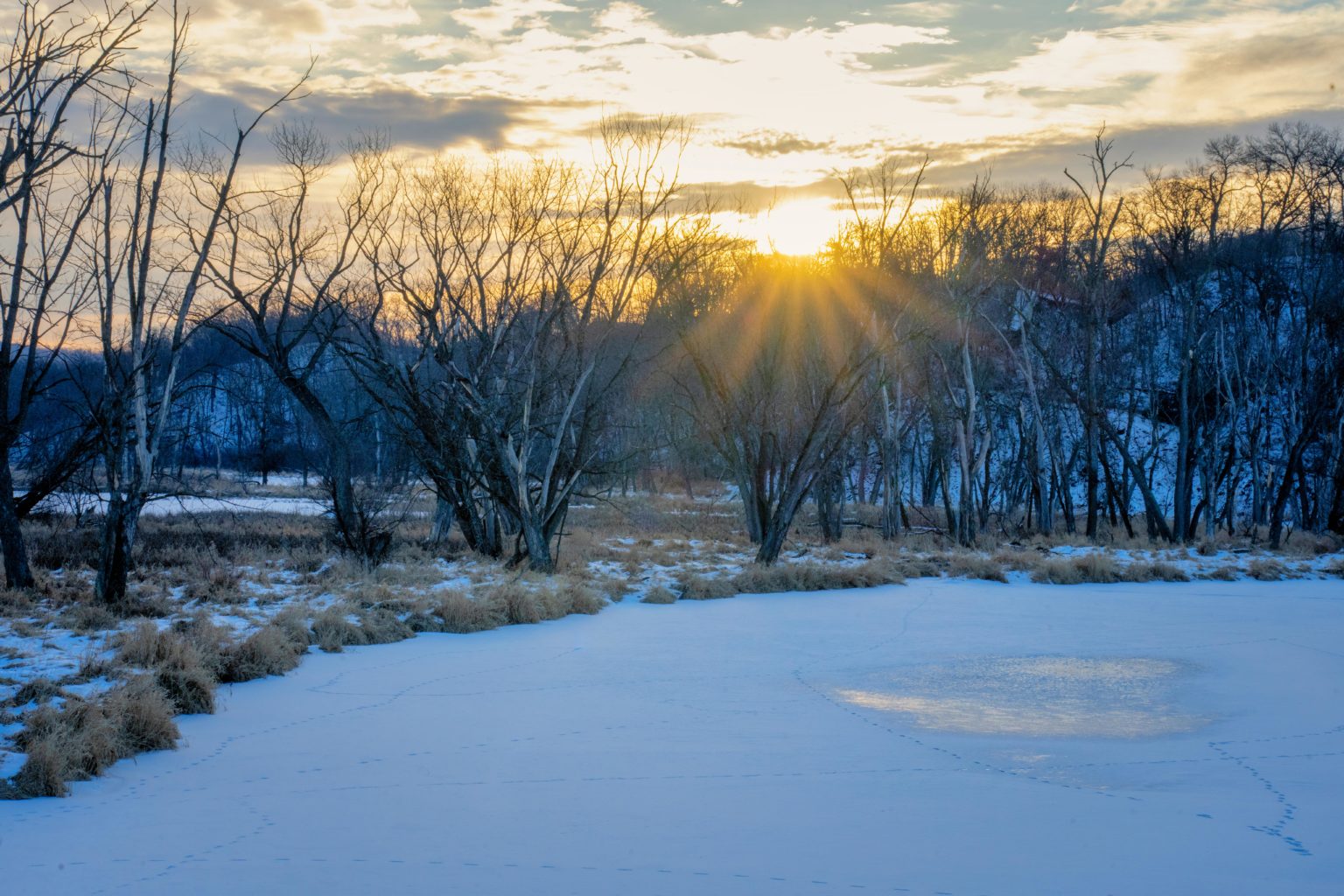
I try to take a long walk most days, even when the weather is inhospitable. As it was this week in Iowa, with windchill below zero.
Sometimes on my walk, I observe what there is to see–a fruit tree which stubbornly hangs on to its apples that are now golden brown and mushy, the swirly pattern of ice on a pond with geese waddling across (why don’t they just fly, I wonder?), the sun peaking briefly through a cluster of clouds.
Other days, I listen to a recorded dharma talk from a favorite Buddhist teacher, to help me accept the walking conditions as they are, rather than what I’d like it to be. Oppressively gray skies, wind filled with moisture cutting across my face, worn out glutes walking uphill.
I recently listened to a dharma talk where the teacher referred to a quote from Rudyard Kipling in his book, Kim:
“This is a great and terrible world.”
Stepping into 2026, and leaving 2025, these words hit home. The new year coming upon me feels different because of all that I’ve experienced this year. Maybe COVID was a dry run through for the powerlessness and fear that seems to be so prevalent now. I admit that I went on a news fast for several months this year, to keep despair and heartbreak at bay, to give my spirit a different focus than the tragedy or anxiety of the hour.
And yet, this is a beautiful world as well. On the days when I don’t feel the need to listen to Buddhist teachings to bring me comfort, I see it with my eyes. I feel it in my heart. I know it in my mind.
What has helped me see that this world is both great and terrible?
For several years, I’ve been interested in my ancestors–first with genealogy research, then with ancestral healing work, and later, in writing letters to my ancestors. Now, I’m working on a book about my ancestors. In my research, I have imagined scenes of great joy and deep sorrow–from my widowed grandfather as a grieving and incapacitated parent to his six-month old baby daughter and seven-year old son (my dad) in the 1930’s to my great-grandfather’s elation on learning that he had passed the Qing dynasty civil service examinations at the provincial level (granting him a lifelong job and membership in the educated class) to a day-long interrogation of my grandmother by immigration inspectors when she first arrived in North America in 1916 to the sense of belonging and camaraderie that my father felt when he joined an all-Chinese unit of the U.S. Army to fight in WWII.

Photo by Suzy Hazelwood
Getting to know my ancestor’s lives has allowed me to take the long view of whatever is happening today. They endured, so that I might exist. My ancestors might have thought they were just getting on with things, but as a descendant, I know better. As ugly and harsh as many of the events were in their lives, there was also a hidden purpose. I need only look at my siblings, children, cousins, nieces and nephews and more recently, great nieces and great nephews to see this purpose in sharp relief.
This world is both great and terrible.
To see only the light or only the dark is to miss the mystery of being human. To obsess on the pieces that grab my attention in the moment is to disregard the complexity of the whole. To feel grief at the expense of joy is to close down the full range of human experience.
It is the mystery that sustains me. It is the whole that restores me. It is the full range that opens me to possibility.
In 2026, may you feel the mystery, see the whole, and experience the full range of all that life has to offer.